
SEO and AI Search Visibility for B2B Technology Companies
A practical guide to SEO and AI search visibility: useful buyer content, crawlable pages, clear expertise, source quality, and meaningful measurement.
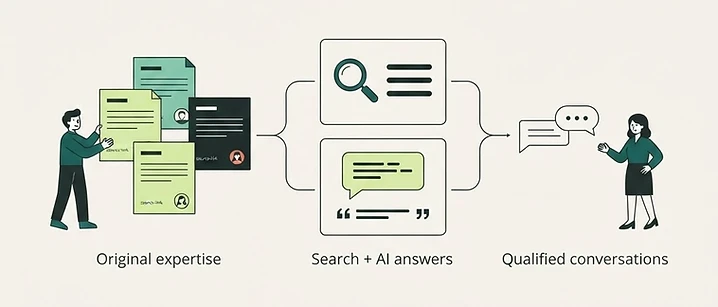
Search is how B2B technology buyers research before they ever contact you. AI-assisted answers are becoming part of that research. The companies whose expertise is clear, original, and well-structured are the ones best positioned to be found — in traditional results and in AI-assisted summaries.
This guide defines the fundamentals in plain language and explains what you can and can't control.
SEO and GEO, defined
SEO (search engine optimization) is the practice of making your content eligible to appear in traditional search results for the queries your buyers use.
GEO (generative engine optimization) is the practice of making content more likely to be referenced by AI-assisted answers. The two overlap heavily — both reward useful, well-structured, source-backed content. Google's own guidance says AI search relies on the same fundamentals as regular search, with no special AI markup required.
Eligibility, visibility, citations, visits, conversions
These are not the same thing:
- Eligibility: Your page can be crawled and indexed.
- Visibility: Your page appears in results for a query.
- Citations: Your content is referenced by an AI-assisted answer.
- Visits: A user clicks through to your site.
- Conversions: That visitor takes a meaningful action.
Each is a separate stage. Improving one doesn't guarantee the next. Measuring only visits (or only impressions) hides where the funnel actually breaks.
Research buyer questions, not just keywords
Keywords tell you what people type. Buyer questions tell you what they're trying to decide. Build content around the questions a buyer asks during evaluation — 'how do I choose,' 'what's the difference between,' 'what does this cost to operate' — not just keyword variants of your service name.
Build service and topic clusters
Instead of thin pages targeting keyword variants, organize content into clusters: a pillar page for a core topic, supported by detailed pages answering specific questions. This serves buyers (who get a coherent research path) and search (which sees topical depth).
Create original expertise
AI-assisted answers synthesize existing content. If your content says what everyone else says, there's nothing to cite. Original expertise — your frameworks, your examples, your point of view — is what makes you referenceable. Generic content wins in neither search nor AI.
Make pages crawlable
Technical discoverability is table stakes: crawlable pages, clean URLs, fast load times, no blocking of search crawlers. Check that OAI-SearchBot (OpenAI's search crawler) isn't unintentionally blocked if you want your content discoverable in AI-assisted search. Training-crawler choices are separate from search discovery.
Strengthen source quality
AI-assisted answers favor content that cites sources and demonstrates expertise. Link to primary sources. Show authorship. Make claims verifiable. Content that can be checked is more likely to be trusted — by humans and by systems.
Use truthful structured data
Schema markup helps search engines understand your content. Use it where it fits — Organization, WebSite, BreadcrumbList, BlogPosting — and keep it truthful. Structured data does not guarantee rich results or AI inclusion.
Maintain your content
Search and AI answers favor current, maintained content. Audit periodically: update what's stale, consolidate what's fragmented, remove what's no longer useful. A content maintenance plan is part of SEO, not an afterthought.
A compact audit table
| Issue | Check | Next action | |---|---|---| | Thin pages | Does this page answer a real buyer question? | Expand, consolidate, or remove | | Crawlability | Is the page indexed? | Check Search Console; fix blocking | | Source quality | Are claims backed by sources? | Add citations and authorship | | Structure | Is there one clear H1 and hierarchy? | Rewrite headings | | Maintenance | When was this last updated? | Refresh stale content |
Schema and llms.txt don't guarantee inclusion
An llms.txt file is optional supplemental information about your content. It does not guarantee AI citations. Schema does not guarantee rich results. Neither is a ranking claim or a dependency. Use them where they add real value; don't treat them as a shortcut.
Measure what matters
Track visibility for the terms that matter, referral visits, and — most importantly — the inquiry quality of the leads that arrive from search and AI-assisted discovery. Don't report ranking trophies. The goal is qualified conversations, not position one for a term no buyer uses.
FAQs
Can you guarantee we'll appear in AI Overviews? No. No one can. Google's guidance says AI search relies on the same fundamentals as regular search. We build for that; we don't promise citations.
Do we need an llms.txt file? It's optional. It can help AI systems understand your content, but it doesn't guarantee inclusion. We use it where it adds value, not as a checklist.
How do we know if AI search is working? Look at referral visits from AI-assisted sources where observable, and at the inquiry quality of the leads that arrive. Don't label all direct traffic as AI traffic.
Find the gaps in how buyers discover your expertise. Book a Strategy Call.
Related: SEO & AI Search service · Website Development service · Cybersecurity Marketing That Helps Buyers Make a Decision
Want to put this into practice?