
Cybersecurity Marketing That Helps Buyers Make a Decision
Strong cybersecurity marketing helps practitioners and business sponsors evaluate the same offer from different perspectives — with evidence, not adjectives.
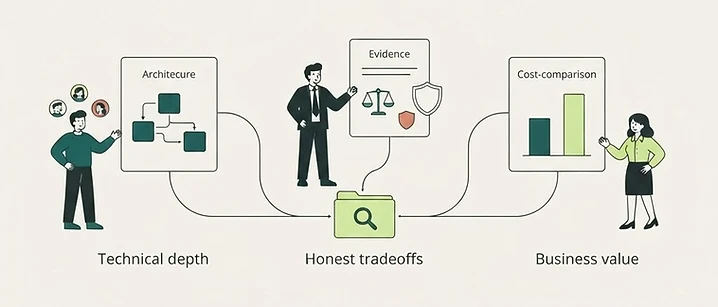
Strong cybersecurity marketing helps practitioners and business sponsors evaluate the same offer from different perspectives. The challenge is that those perspectives rarely agree on what 'good' looks like — and most vendor content serves neither of them well.
The 2026 NOLA Marketing/Ponemon study, surveying 320 enterprise security decision-makers, reports gaps in technical depth and ROI justification in how buyers evaluate vendors. The study's sample is enterprise; its findings should not be extrapolated to every small firm. But the signal is clear: buyers want more technical substance and better business justification than most marketing provides.
Buying committees are the norm
A cybersecurity purchase usually involves at least three perspectives: the practitioner who will operate the tool, the security leader who owns the risk, and the financial sponsor who approves the spend. Each asks different questions. Marketing that speaks to only one — usually the fear of the executive — fails the others.
What each stakeholder needs
| Stakeholder | Question | Evidence needed | Suitable content | |---|---|---|---| | Practitioner | How does this actually work? | Technical detail, integration | Architecture explainer, API docs | | Security leader | Does this reduce my risk? | Honest tradeoffs, scope | Comparison, threat model | | Financial sponsor | Is this worth the cost? | Risk and cost framing | Business case, ROI framing |
Technical depth builds trust
Practitioners respect content that respects their expertise. A page that explains detection logic, integration points, and operational requirements — honestly, including limitations — earns more credibility than one that promises to 'stop all threats.' Vagueness reads as a lack of substance, and in security, that's disqualifying.
Business relevance closes the deal
The security leader and the financial sponsor need to connect the technical capability to risk and cost. That doesn't mean inventing ROI numbers. It means framing the tradeoff: what this replaces, what it reduces, what it costs to operate, and what happens if you don't act.
Honest tradeoffs beat absolute claims
Every security control has tradeoffs: performance impact, operational burden, false positives, coverage gaps. Naming them builds trust; hiding them destroys it. A buyer who discovers an undisclosed limitation during evaluation remembers it. A buyer who was told upfront respects the honesty.
Explain integration, don't assume it
'Integrates with your stack' is not an explanation. Which tools? What does the integration actually do? What does it require? Integration detail is often the deciding factor, and it's where most vendor content is thinnest.
Useful demonstrations
A demo should help the buyer evaluate, not just impress. Show the actual workflow, the actual alerts, the actual decisions an operator makes. A staged demo that hides the hard parts teaches the buyer nothing and sets up a disappointed customer.
Evidence review
Back claims with evidence: test results, methodology, third-party assessments where they exist. If you can't support a claim, don't make it. Security buyers check.
Sales enablement
Give sales the content that answers each stakeholder's questions — technical, operational, and financial — so the conversation doesn't stall when a new person joins the evaluation.
Illustrative example: revising vague protection language
Illustrative example. A detection and response vendor leads with 'Stop threats fast.' We revise it:
- Before: 'Stop threats fast with AI-powered protection.'
- After: 'Detect endpoint threats in an average of under 60 seconds, with alerts routed to your existing SIEM. Reduces mean-time-to-respond for teams operating without 24/7 coverage. Requires a deployed agent on each endpoint.'
The revision is scoped, honest about what it does and what it requires, and gives each stakeholder something real to evaluate. It doesn't promise to eliminate risk.
FAQs
How technical should our marketing be? Technical enough that a practitioner respects it. You don't need to publish your source code, but you do need to explain how the product works in terms an operator recognizes.
Should we publish test results? If you have credible, methodologically sound results, yes — with the methodology. If you don't, don't fabricate or imply them.
How do we justify the cost to a CFO? Frame the tradeoff honestly: what this replaces, what risk it reduces, what it costs to operate. Don't invent ROI; explain the value in terms a financial sponsor can evaluate.
Make your technical value easier to evaluate. Book a Strategy Call.
Related: Cybersecurity audience page · GTM Strategy service · SEO and AI Search Visibility
Want to put this into practice?