
MSP Lead Generation: Build a Pipeline Beyond Referrals
A repeatable acquisition process connects a specific customer problem with a credible offer and a clear next step. More contact volume alone does not solve it.
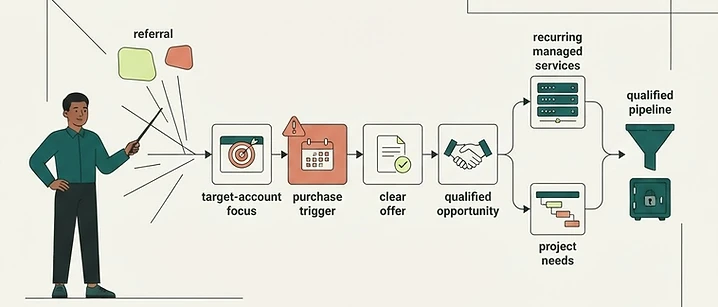
A repeatable acquisition process connects a specific customer problem with a credible offer and a clear next step. More contact volume alone does not solve the problem — it just creates more noise for a sales team that already has too little time.
For managed service providers, this matters more than in most industries. Many MSPs grew on referrals, which are wonderful when they arrive and useless as a forecast. When referrals slow down — and they always do, cyclically — the firm discovers it has no repeatable way to put its offer in front of the buyers who would actually choose it.
The good news: a pipeline beyond referrals is buildable. It starts with focus, not volume.
Start with target-account fit
Before any outreach, define the account you want to acquire. For most MSPs, this means choosing a segment — by size, industry, geography, or technical need — where your service genuinely fits and your team can deliver well. A focused ICP makes every later step more efficient: the content is more relevant, the offer is clearer, and the qualification is faster.
Kaseya's 2026 State of the MSP report, drawing on more than 1,000 MSPs, identifies acquisition difficulty and smaller contracts among its themes — alongside AI and automation as a differentiation lever. The implication is not to do more marketing; it's to make the marketing more focused and the offer more valuable.
Map the purchase triggers
MSP services are bought when something triggers a review: a compliance deadline, a security incident, a staff departure, a contract renewal, or a growth event. Map the triggers that start a buying motion for your segment, and build content and outreach around them. Trigger-based outreach reaches buyers when they're already evaluating, not when they're indifferent.
Separate recurring from project needs
A recurring managed services buyer and a project buyer (a migration, an assessment, a remediation) have different motions, different decision-makers, and different timelines. Treat them as two offers with two paths. Trying to sell both with one message blurs both.
Make the offer clear
'Co-managed IT' means something different to every provider. Define what's included, who it's for, and what changes for the buyer. An offer that can't be described in two sentences can't be chosen quickly.
Build decision-stage pages
Most MSP websites list services and stop. A decision-stage page answers the buyer's real question: how do I choose between providers like you? It compares options honestly, explains the tradeoffs, and gives the buyer a way to evaluate before they talk to anyone. This is the page that converts an evaluator into an inquirer.
Plan distribution to where the buyer looks
Distribution is a planning decision. For MSPs, that often means a focused outreach sequence to named accounts, a presence where IT leaders research (search and peer communities), and content that existing clients can forward. Choose two or three channels you can sustain, not seven you can't.
Handle leads with a definition of qualified
Agree with sales what 'qualified' means before the campaign launches. A submission is not a lead. A valid inquiry is a real person with a relevant question. A qualified opportunity is one sales has accepted as worth pursuing. Measure all three separately so you can see where the pipeline breaks.
A practical first 90 days (planning example)
This is a planning example, not a performance benchmark:
| Phase | Focus | Output | |---|---|---| | Days 1–15 | Define ICP, triggers, and offer | A one-page segment brief | | Days 16–45 | Build decision-stage page and outreach sequence | A live capture path | | Days 46–90 | Run outreach, handle responses, review weekly | A qualified pipeline and a feedback loop |
Buyer situation, content, and qualification
| Buyer situation | Relevant content | Next action | Qualification question | |---|---|---|---| | Renewal approaching | Comparison guide | Download or request review | When does your current contract end? | | Staff departure | Co-managed vs. fully managed explainer | Book a call | How large is your internal IT team? | | Compliance deadline | Readiness checklist | Request assessment | Which framework applies to you? |
Illustrative example: a co-managed IT campaign
Illustrative example. A midmarket MSP wants to grow co-managed IT with companies that have a small internal team. The campaign defines the segment (50–250 employees, one to three internal IT staff), builds a decision-stage page comparing co-managed to fully managed, and runs a focused outreach sequence to 60 named accounts. Responses route to sales with a qualification checklist. The measure is accepted opportunities from target accounts — not raw submissions. No results are claimed; this is a hypothetical campaign design.
FAQs
How long until a referral-independent pipeline works? A focused effort typically shows qualified pipeline within a quarter, but this depends on segment, offer, and sales follow-up. Treat early results as signal, not proof.
Do we need to cold-call? Not necessarily. Targeted outreach to named accounts — email, LinkedIn, or introduced — often outperforms cold calling for MSP services. The right channel depends on your buyers.
Should we offer an assessment? An assessment can be a strong first step if it's scoped and valuable, not a disguised sales pitch. Make sure it leads somewhere useful for the buyer.
Let's map a better acquisition path for your MSP. Book a Strategy Call.
Related: MSP audience page · Lead Generation service · From Form Fill to Qualified Opportunity
Want to put this into practice?