
From Form Fill to Qualified Opportunity: Fixing B2B Lead Quality
Connect form quality, fit, qualification, CRM routing, and follow-up so your team can measure more than raw submission volume.
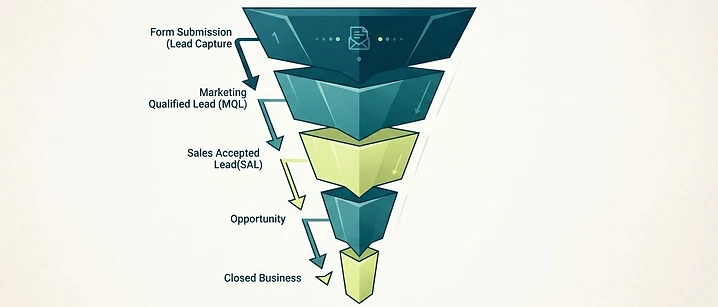
A legitimate submission, a good-fit account, and a qualified opportunity are different things, and they should be measured separately. When marketing reports only 'leads,' it hides where the pipeline actually is — and where it breaks.
The problem with raw submissions
A form fill feels like progress. But a submission can be a student, a competitor, a job seeker, an automated bot, or a real buyer. Lumping them together inflates the number and frustrates sales. The first job is to separate what a submission is from what it isn't.
Unwanted submissions
Automated and irrelevant submissions waste sales time and distort reporting. Basic validation — honeypot fields, timing checks, input limits — reduces the noise. But validation can only assess submission quality; it can't establish budget, authority, need, or purchase intent. That's a later job.
Qualification inputs
Qualification happens in stages, not all at once. Early signals (company, role, message content) suggest fit. Deeper signals (timeline, budget, decision process) come from a conversation. Don't try to qualify fully at the form; you'll either ask too much or guess too little.
A stage model
This is an example operating model, not a universal standard:
- Submission — something arrived in the system.
- Valid inquiry — a real person with a relevant question.
- Fit-qualified inquiry — the account and role match your ICP.
- Accepted opportunity — sales has agreed to pursue it.
- Closed business — the deal is won.
Measuring each stage separately shows where demand breaks down. If you have many submissions but few valid inquiries, the form or offer is the problem. If you have fit-qualified inquiries but few accepted opportunities, the handoff or the offer is the problem.
Routing
Inquiries need to reach the right person fast. Routing by service interest, geography, or account tier reduces manual handling and speeds response. The marketing-to-sales handoff is where most pipeline leaks — not at capture, but in the gap between systems.
Duplicate management
Duplicate submissions multiply when forms are easy and follow-up is slow. Deduplicate against existing records before creating new ones. A clean CRM is a useful CRM.
Response ownership
Someone owns the first response, and it's clear who. Unowned inquiries die. Define ownership before the campaign launches, not after.
Sales feedback
The fastest way to improve lead quality is a feedback loop: sales tells marketing which inquiries were useful and which weren't, and marketing adjusts. Without this loop, both sides guess.
Opportunity definitions
Agree what 'opportunity' means before you measure it. If marketing and sales define it differently, the pipeline number is meaningless. Write it down.
Source tracking and attribution limits
Track where inquiries came from — source, medium, campaign, landing page, referrer. But know that attribution is incomplete: buyers research across channels before they submit, and the last click rarely tells the whole story. Use attribution as a signal, not a verdict.
Example conversion formulas
These are example formulas with explicit denominators — no historical numbers are claimed:
- Valid inquiry rate = valid inquiries ÷ submissions
- Fit-qualification rate = fit-qualified inquiries ÷ valid inquiries
- Opportunity acceptance rate = accepted opportunities ÷ fit-qualified inquiries
- Close rate = closed business ÷ accepted opportunities
Each denominator is explicit. Measure the rates, not just the counts.
The limited role of form evaluation
Form evaluation — like the work 221 Labs does with its FIRE (Form Intelligence Risk Evaluation) approach — can help with submission quality: identifying unwanted or suspicious submissions before they reach connected downstream systems. It cannot, by itself, establish that a real submission is a qualified opportunity. That requires a conversation. 221 Labs is a Topic Digital product, shared here transparently; it doesn't claim universal compatibility or perfect detection.
FAQs
What's the difference between a lead and an opportunity? A lead is a submission. A valid inquiry is a real person. A fit-qualified inquiry matches your ICP. An accepted opportunity is one sales has agreed to pursue. Measuring all of them separately shows where the pipeline actually is.
Can form evaluation qualify leads for us? It can help with submission quality — filtering unwanted or suspicious entries. It can't establish budget, authority, need, or intent. That's a conversation, not a form.
How do we improve lead quality? Start with a feedback loop between sales and marketing, a shared definition of qualified, and a stage model that separates submission from opportunity. Then adjust the offer, the form, and the channels based on what the stages tell you.
Improve the path from inquiry to a useful sales conversation. Book a Strategy Call.
Related: 221 Labs product page · Marketing Automation & CRM service · Lead Generation service · MSP Lead Generation Beyond Referrals
Want to put this into practice?